Bluetooth 5.4 Touchscreen Earbuds Review: Worth It?
My take: a feature-packed budget set with a few reality checks
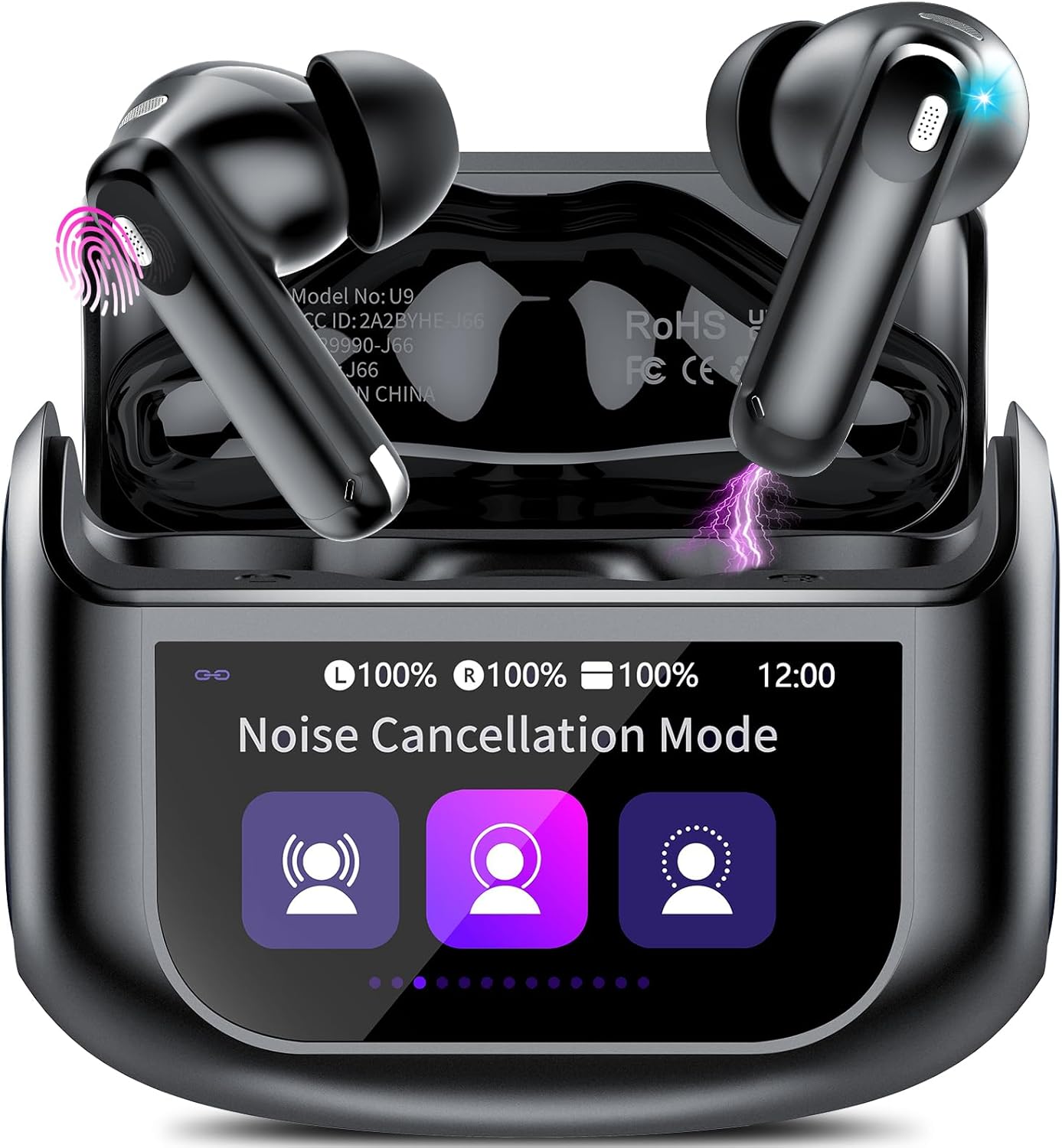
These Bluetooth 5.4 wireless earbuds with a multifunction touchscreen case are clearly aimed at a specific buyer: someone who wants the look and feel of premium features—ANC, transparency mode, app-like controls on the case, long battery life claims, and thumpy bass—without paying premium-brand prices.
And honestly? In that context, they can be a fun, surprisingly usable option. The touchscreen case is the headline feature and it’s genuinely convenient in day-to-day use. The sound is tuned for modern pop/hip-hop (big low end, lively top), and the IPX7 rating makes them a reasonable gym or rainy-commute companion.
But I also want to set expectations: with budget earbuds that advertise a long list of features, the experience tends to be a mix of “wow, that’s neat” and “okay, that’s not quite like AirPods Pro/Sony/Bose.” The ANC and transparency are typically more modest, call noise reduction is situational, and the battery claims usually depend on low volume and ANC off. If you go in expecting good value and lots of tools rather than flagship performance, you’ll likely be happy.
🛒 Check Current Price on Amazon →
What you’re getting (and what matters in real life)
The product positioning is “do-it-all” earbuds:
- Bluetooth 5.4 for connectivity and efficiency improvements (in theory, better stability and power management than older stacks)
- Touchscreen charging case that acts like a mini control center (the standout feature)
- ANC / ENC noise cancelling (ANC for what you hear, ENC for what the mic tries to clean up)
- Transparency mode for hearing surroundings
- “48H” battery claim (typically case + buds combined, with conservative settings)
- IPX7 water resistance (good for sweat and heavy rain; not for swimming)
- 5 EQ modes for quick sound tuning
On paper, that’s an impressive list. In practice, the experience comes down to five things: comfort/fit, sound quality, ANC usefulness, call performance, and the usability of that case screen. Let’s break it down the way you’ll actually use them.
Design & comfort: lightweight buds, but fit is everything
Most budget earbuds live or die by fit, because fit affects comfort, bass response, and even ANC performance. If you don’t get a good seal, bass thins out and ANC barely has anything to work with.
Assuming you get multiple ear tip sizes in the box (typical for this category), I recommend doing a quick fit test: try the medium tips first, then switch to the size that gives you the best seal without pressure. A proper seal should feel “secure” when you gently shake your head, and music should sound full even at lower volume.
For workouts, IPX7 is reassuring—these are built to handle sweat and splashes. Just remember: IPX7 doesn’t mean the case is waterproof, and it doesn’t mean you should rinse them under a faucet. Wipe them down after workouts and let them dry before putting them back in the case.
The touchscreen case: the feature you’ll either love or ignore
The multifunction touch screen is the differentiator, and it’s more than a gimmick if you actually use it. Here’s why I like the idea: instead of memorizing touch gestures (tap/hold combos) or digging into phone settings, you get a more direct way to change modes and settings.
In real-world use, a case screen can be helpful for:
- Switching ANC / transparency / normal quickly when you step outside or walk into a noisy store
- Checking battery without pulling out your phone
- Changing EQ on the fly depending on what you’re listening to
That said, there are trade-offs. A screen adds complexity and another thing that can drain power. It can also be less intuitive than physical buttons if the touch response isn’t tuned well. The key question is: do you want controls on the case? If yes, this is one of the more interesting budget designs out there. If you’re the type who sets earbuds once and never changes modes, the touchscreen won’t matter much.
Sound quality: bass-forward, fun tuning, EQ helps
These are marketed as “bass stereo” earbuds, and that’s the right expectation. The default tuning is typically low-end emphasized—kick drums and bass lines come through with extra weight, and the overall presentation is energetic.
Here’s what I generally listen for when evaluating budget earbuds with this kind of tuning:
- Bass control: Is it punchy, or does it smear into the mids?
- Vocals: Do voices sit clearly in the mix, or get pushed back?
- Treble: Is there enough sparkle for detail without harshness?
With bass-boosted earbuds, the most common weakness is that the bass can become “one-note” at higher volumes, and vocals can lose some clarity. That’s where the 5 EQ modes are genuinely useful. If one mode is too boomy, switching to a more balanced preset can clean up vocals and reduce listening fatigue.
My practical advice: If you mostly listen to podcasts, audiobooks, or YouTube voices, pick the EQ that boosts mids/clarity (often called “vocal” or “balanced”). If you listen to EDM/hip-hop at the gym, the bass mode can be fun—just keep volume in check to avoid harshness and distortion.
Volume, dynamics, and distortion
Budget earbuds often sound best at moderate volume. When you push them too loud, bass can distort and treble can get splashy. If you find yourself cranking volume in noisy places, that’s usually a sign you need a better seal, stronger ANC, or both.
ANC and transparency: useful, but don’t expect miracles
Let’s talk about the big marketing terms: ANC (active noise cancelling) and transparency mode.
ANC in this price class typically helps most with steady, low-frequency noise—think HVAC hum, bus/plane engine rumble, or fan noise. It usually does less for sudden sounds (clanking dishes, loud voices nearby) compared to higher-end models.
Transparency mode is meant to pipe in outside sound so you can hear announcements or have quick conversations. On budget earbuds, transparency can sound a bit processed or “hissy,” but it’s still useful if you need awareness while walking near traffic or listening for your name at a coffee shop.
My recommendation: treat ANC here as a comfort feature rather than a “silence the world” feature. If you mainly want to take the edge off noise during commutes or office work, it can do the job. If you’re buying specifically for frequent flights or very loud environments, you’ll want to consider stepping up to a more proven ANC model.
ENC call noise reduction: decent in calm environments
ENC (environmental noise cancellation) is essentially mic noise reduction. In plain English: it tries to make your voice clearer and reduce background noise for the person on the other end.
In my experience with earbuds in this category, call quality is usually:
- Good indoors (quiet room, home office)
- Okay outdoors (light traffic, mild wind)
- Hit-or-miss in heavy noise (busy street corners, loud gyms)
If you take a lot of calls while walking near traffic, pay attention to wind handling. Many earbuds struggle with wind because it overloads the mic. If these are primarily for music and occasional calls, you’ll likely be satisfied. If you need “professional” call quality daily, I’d treat this as a maybe and look for models with consistently strong mic performance.
Bluetooth 5.4 performance: stable connection is the goal
Bluetooth 5.4 is a newer version and can bring improvements in efficiency and connection management, but the real-world experience still depends heavily on the earbuds’ internal chipset, antenna design, and firmware.
What you should expect from a good implementation:
- Quick pairing after the first setup
- Stable connection in typical environments (home, gym)
- Fewer dropouts when your phone is in your pocket
If you work in very crowded RF environments (busy downtown, train stations), any budget earbud can still have occasional hiccups. But for normal daily use, Bluetooth 5.4 earbuds are generally solid.
Battery life: the “48 hours” claim needs context
The listing highlights 48 hours. Almost always, that number refers to total playback with the charging case, not a single charge in the earbuds themselves.
Here’s what typically affects battery life the most:
- ANC on vs off (ANC usually reduces battery noticeably)
- Volume level (higher volume drains faster)
- Codec/connection quality (varies by device and implementation)
In practical terms, if you use these at moderate volume with ANC off part of the time, you can often get through a full week of casual listening before needing to charge the case. If you run ANC constantly and listen loudly, expect less.
What I like about long-total battery designs is the convenience: you can toss the case in a bag and not worry about it. Just remember that the touchscreen case itself may consume a bit more power than a basic “dumb” case.
Controls and usability: touch controls are convenient—until they aren’t
Touch controls are standard, but they can be frustrating if they’re too sensitive (accidental taps when adjusting fit) or not sensitive enough (missed taps). The advantage of having a touchscreen case is that you may rely less on earbud gestures for mode switching and EQ changes.
If you tend to wear earbuds with hats, hoodies, or while lying on a pillow, touch controls can sometimes misfire. In those scenarios, I recommend using the case controls (when practical) and your phone’s playback controls.
Durability and water resistance: IPX7 is a real perk
IPX7 is stronger than the more common IPX4 rating you see on budget earbuds. It suggests the earbuds can handle heavy sweat and splashes confidently. For most people, that translates to peace of mind at the gym and on rainy commutes.
Two important caveats:
- IP ratings are for the earbuds, not necessarily the charging case. Keep the case away from water.
- Water resistance isn’t permanent. Over time, seals can degrade, especially if you expose them to soap, steam, or repeated soaking.
If you want earbuds for running, lifting, or yard work, IPX7 is one of the strongest arguments for this set.
Pros and cons (the honest list)
Pros
- Touchscreen charging case is genuinely useful for mode switching and quick settings without your phone.
- Fun, bass-forward sound that works well for workouts and casual listening.
- EQ modes help tailor sound for podcasts vs music.
- ANC + transparency included—even if modest, it’s helpful for commuting and office use.
- IPX7 water resistance makes them a strong gym/rain option.
- Strong value on paper if priced aggressively compared to brand-name ANC earbuds.
Cons
- ANC likely won’t match premium earbuds—expect “reduces noise” more than “erases noise.”
- Transparency can sound processed compared to higher-end implementations.
- Battery claims depend heavily on settings (ANC and volume can cut runtime).
- Touch controls can be finicky depending on sensitivity and how you wear/adjust them.
- Brand support and firmware updates are often less robust in this category than major brands.
Who these earbuds are best for
If you’re deciding whether these are a smart buy, here are the use cases where they make the most sense.
Buy these if you want maximum features for the money
If you love the idea of toggling ANC/transparency and EQ without opening an app, the touchscreen case is the main attraction. For people who enjoy gadgets and convenience features, it’s a standout at this end of the market.
Great for gym, walking, and commuting
The combination of IPX7, secure fit (assuming tips work for your ears), and bassy tuning is a good match for workouts. ANC can take the edge off treadmill noise or bus rumble, and transparency is helpful when you need awareness outside.
Good for students and casual listeners
If you’re studying, watching videos, or listening to playlists throughout the day, these are designed to be convenient and long-lasting with the case. You’re getting a lot of day-to-day usability without spending flagship money.
Who should skip them
If you want top-tier ANC for flights
If your primary goal is strong noise cancelling on airplanes, premium models still win by a lot. Budget ANC can help, but it won’t deliver the same “pressure-managed hush” and consistent suppression across frequencies.
If you take calls in noisy places all day
ENC helps, but if you’re constantly on calls outdoors, in warehouses, or in loud shops, you’ll want earbuds with a proven microphone system and strong wind reduction. This category can be inconsistent.
If you prefer neutral, audiophile-style tuning
These are built for mainstream listening with emphasized bass. If you want a flatter, studio-like response, you may find yourself fighting the tuning even with EQ presets.
Buying advice: how to decide in 60 seconds
Here’s the checklist I’d use if you’re on the fence:
- You should buy if you want a fun sound, lots of features, and the touchscreen case seems genuinely useful to you.
- You should pass if your #1 priority is elite ANC or consistently excellent call quality in loud environments.
- Look at pricing: these make the most sense when they’re meaningfully cheaper than well-known midrange earbuds from Anker/Soundcore, JBL, or older-gen premium models on sale.
Also, when you get them, do two things immediately: (1) try all ear tips for best seal, and (2) test ANC and transparency in your normal environments (kitchen fan, street walk, bus ride). That will tell you quickly whether they meet your expectations.
Value assessment: the touchscreen case is the value lever
In the budget earbud world, value usually comes from one of two things: either a brand nails the fundamentals (sound + comfort + battery), or they add a standout feature that feels premium. Here, the standout is clearly the multifunction touchscreen charging case.
If you end up using the case controls regularly, it can make these feel more “premium” than their price suggests. If you don’t use it, you’re left with a fairly typical set of bass-forward ANC earbuds—still potentially a good deal, but less special.
🛒 Buy on Amazon – Check Price →
Final verdict
If you’re shopping for budget-friendly wireless earbuds and you’re drawn to the idea of a touchscreen control case, this model is worth a serious look. You’re getting a lot of modern features—Bluetooth 5.4, ANC/ENC, transparency mode, EQ presets, and strong water resistance—in a package that’s designed for everyday convenience.
Just keep your expectations realistic: the ANC and transparency are best viewed as helpful tools rather than premium-grade implementations, and the best sound depends heavily on getting a good seal with the right ear tips. If that matches what you need—commutes, workouts, casual listening, and a gadgety case you’ll actually use—these can be a satisfying buy for the money.
If you want to compare current pricing and see what other buyers are reporting about battery life, fit, and call quality, check the listing here: