Emergency NOAA Radio Review: Worth It in 2026?
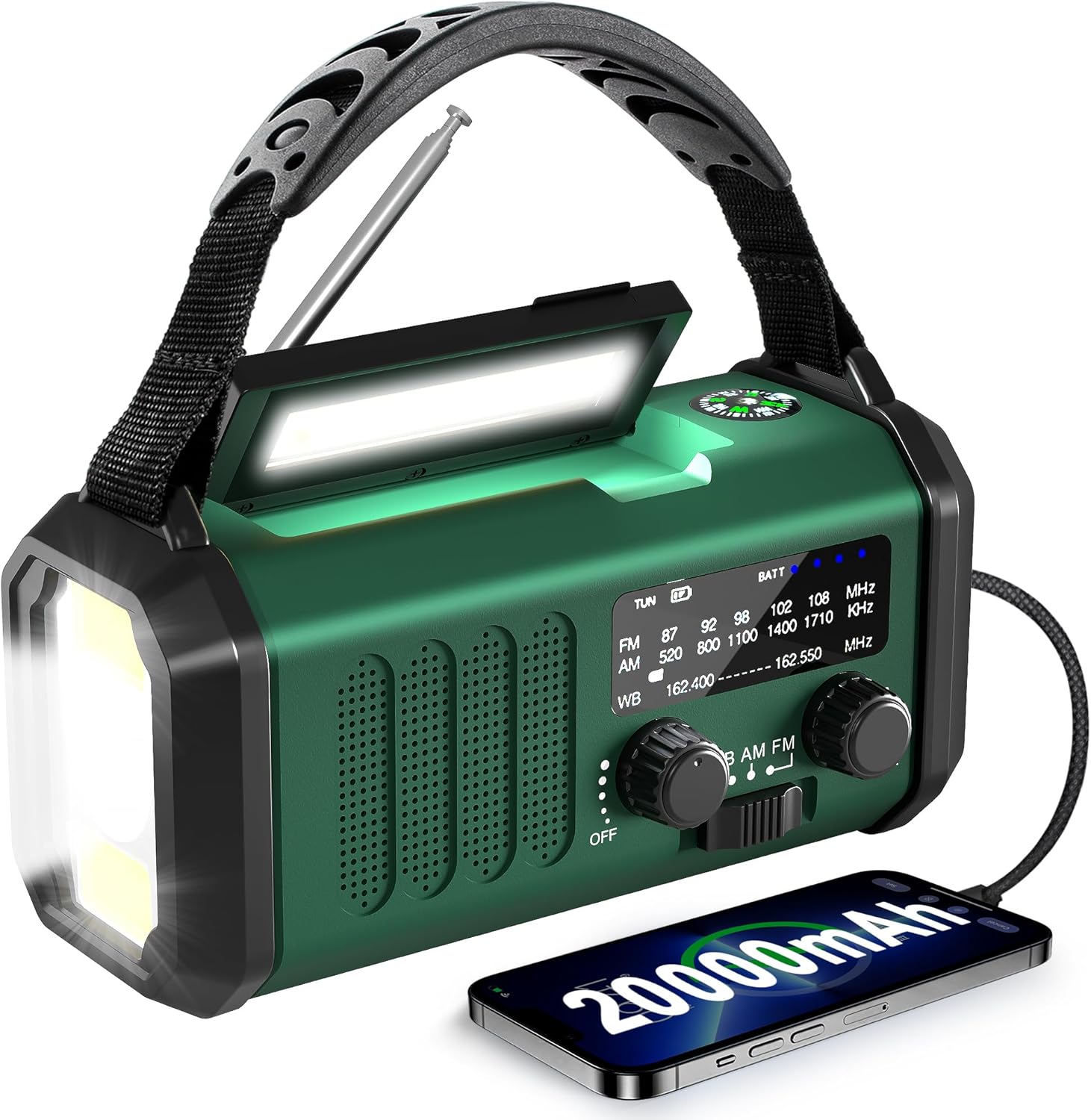
Emergency Radio-NOAA 20000mAh Review (Solar/Crank/AC)
If you’re shopping for an emergency radio, you’re probably not looking for a “fun gadget.” You want something that works when the power is out, cell towers are spotty, and you need reliable information (weather alerts, local AM/FM stations) plus a little bit of light and backup power for a phone.
The product with the very long name—Emergency Radio-NOAA Weather Radio 20000mAh/74000mWh with AM/FM Portable Solar Panel/Hand Crank/AC Input Rechargeable Battery and Flashlight SOS Siren Lamp—is a classic “all-in-one” emergency unit: NOAA weather band, AM/FM, multiple charging options (AC, solar, hand crank), a flashlight/lamp, and an SOS siren. On paper, that’s exactly the checklist most people want for home outages, hurricanes, tornado season, and camping backups.
In this review, I’ll walk you through what matters in the real world: how usable the radio is, what to expect from the big advertised battery, whether solar/crank are actually helpful (or just marketing), and whether this is a good value compared to other emergency radios.
🛒 Check Current Price on Amazon →
What You’re Actually Buying (And Why It’s Popular)
This category of product has exploded because it combines three things most households realize they’re missing the first time the lights go out:
- Information (NOAA weather alerts and local AM/FM broadcasting)
- Light (flashlight and/or area lamp)
- Power (a built-in rechargeable battery that can top up a phone)
This model leans heavily into the “power” part with an advertised 20,000mAh / 74,000mWh battery. That’s much larger than the typical 2,000–10,000mAh emergency radios and is one reason people click on it. The other reason: it offers three ways to recharge—AC input, solar panel, and hand crank—so you’re not stuck if you can’t plug it in.
That said, “all-in-one” devices always involve tradeoffs. A radio that’s also a power bank and a lantern and a siren can be great—unless one of those features is weak enough that it becomes the thing you’re relying on at the worst time.
Key Features (The Ones That Matter)
Here are the core features that most buyers care about, and the way I think about them for emergencies:
- NOAA weather radio: Useful for severe weather alerts and forecasts when internet/cell service is down. For many U.S. regions, this is the single most important feature.
- AM/FM radio: In widespread outages, local AM stations in particular can be the last reliable broadcast source for community updates.
- Large internal battery (advertised 20,000mAh): Helps run the radio/lights for longer and can charge a phone in a pinch.
- Charging options: AC for everyday convenience; solar and hand crank for “no grid” scenarios.
- Flashlight + lamp: A focused beam is great for tasks; an area lamp is better for lighting a room.
- SOS siren: Can be useful in some scenarios (getting attention), but it’s not something you’ll use often.
Real-World Usability: What It’s Like to Own
Most people don’t think about usability until they’re stressed, it’s dark, and they’re trying to tune a station while also keeping kids calm and phones charged. This is where emergency radios either shine or become frustrating.
Controls and basic operation: With these multi-function units, the learning curve is usually the biggest issue. My advice is simple: once you get it, don’t just toss it in a drawer. Spend 10 minutes learning how to switch bands (AM/FM/NOAA), how to adjust volume, how to turn on the lamp vs flashlight, and how to activate (and deactivate) the SOS siren. In an actual emergency, you want muscle memory, not guesswork.
Portability: Radios like this are typically “portable” in the sense that you can carry them around the house, throw them in a car, or take them camping. But once you add a larger battery and a solar panel, they’re usually bulkier than the tiny hand-crank radios. That’s not necessarily a negative—bigger can mean better battery life—but it does mean it’s more of a home base unit than an ultralight backpacking item.
Everyday storage and readiness: The best emergency gear is the gear you can keep charged and ready. AC charging is what makes that possible. Solar and crank are backups—not your primary plan.
Radio Performance: NOAA + AM/FM (The Make-or-Break Part)
When readers ask me what to prioritize in an emergency radio, I always answer: reception and tuning stability. A huge battery is nice, but if the radio can’t pull in NOAA clearly in your area, it doesn’t matter.
NOAA weather band: NOAA broadcasts are VHF and can be finicky indoors depending on where you live, what your walls are made of, and how far you are from the transmitter. For any emergency radio, you’ll want to test NOAA reception in multiple places: near a window, in a basement, and in the room you’d likely shelter in during severe weather. If the radio includes (or supports) an external antenna, that’s a big plus—though many consumer models rely on a built-in telescoping antenna.
AM reception: AM is the band that often carries emergency updates, but AM is also the band most affected by electrical noise (chargers, LED bulbs, laptops, cheap inverters). In practice, you’ll get the best AM results by turning off nearby electronics and moving the radio away from USB chargers and power strips.
FM reception: FM is generally easier and clearer than AM, but it’s also more “line-of-sight.” If you’re in a fringe area, antenna placement matters a lot.
My practical take: If you’re buying this primarily for emergency information, test it immediately. If NOAA doesn’t come in well where you need it, exchange it while you can. There’s no workaround that beats “a radio that receives well in your location.”
Battery Capacity: 20,000mAh Sounds Amazing—Here’s How to Think About It
The headline spec here is the 20,000mAh (74,000mWh) battery. In plain English, that’s “power bank sized,” and it suggests you could top up a modern smartphone multiple times.
Here’s the reality with any device that advertises mAh:
- mAh is voltage-dependent. Many batteries are rated at ~3.7V internally, but USB output is 5V (or higher for fast charging). Conversion losses are real.
- Usable capacity is lower than advertised once you account for conversion inefficiency and the device’s own power use (radio + lights).
- “20,000mAh class” can still be very helpful even if real-world usable power feels more like a mid-to-high range power bank.
What you should realistically expect: If you’re using it as a phone charger occasionally (short top-ups) and running the radio on and off, a big internal battery can absolutely carry you through a multi-day outage—especially if you’re conservative with brightness and volume. If you expect it to run a bright lantern all night for multiple nights and charge multiple phones to 100% daily, you’ll likely be disappointed. That’s not a knock on this product specifically; it’s just how energy math works.
Value of the big battery: The larger battery is still a major advantage. Most small hand-crank radios are “information-first” devices; they can charge a phone, but it’s slow and limited. This one is positioned more like a radio + lantern + real power bank.
Charging Options: AC vs Solar vs Hand Crank (What’s Useful and What’s Not)
This radio offers three charging paths. Here’s how I’d rank them for real-world reliability:
1) AC Input (Best for Readiness)
AC charging is the reason these devices are practical. You can keep it topped off, and when the power goes out, you’re starting from 100%. If you do one thing right with an emergency radio, do this: charge it fully, then check it monthly.
2) Solar Panel (Good Backup, Slow by Nature)
Built-in solar panels on emergency radios are typically small. That means they’re inherently slow—especially if you’re charging through a window, on cloudy days, or not angled directly at the sun.
How solar is actually useful: Solar is great for “maintenance charging” during extended outages—keeping the battery from hitting zero, or slowly replenishing what you used overnight. It’s usually not a fast “refill from empty” solution.
My advice: If you’re counting on solar, practice with it. Put it outside in direct sun and see how much it helps in your conditions. Treat it as a supplement, not a miracle.
3) Hand Crank (Last Resort)
Hand cranks are physically demanding for the amount of energy they generate. They are best viewed as a way to get minutes of radio time or a small phone boost for an emergency call/text, not as a way to meaningfully recharge 20,000mAh.
If you’ve never used a hand crank radio before, here’s what surprises most people: it’s not hard for 30 seconds, but it gets old fast. Still, I like having it, because when everything else fails, it’s the one charging method that doesn’t care about sunlight or outlets.
Lighting: Flashlight and Lamp Performance
In emergencies, lighting is not just convenience—it’s safety. You want enough light to move around without tripping, to check breakers, to treat a minor injury, or to signal for help if needed.
Flashlight: A focused beam is useful for task lighting. For a radio like this, I’m looking for a beam that’s bright enough to navigate a dark hallway and has a usable hotspot without being too narrow. If it’s overly “spotty,” it can be annoying indoors.
Area lamp: The lamp is what makes these radios genuinely useful in a room. In a power outage, a lamp mode is often more practical than a flashlight because it illuminates a wider area and is easier to set down on a table.
Battery tradeoff: The brighter the lamp, the faster it drains the battery. My recommendation is to use the lowest setting that still feels comfortable, and save full brightness for when you truly need it.
SOS Siren: Useful, But Know When Not to Use It
An SOS siren can be valuable if you’re stranded, injured, or trying to draw attention—especially outdoors. But in many real emergencies (storms, neighborhood outages), blasting a siren can be counterproductive or simply irritate people.
I like having the feature as an option, but I don’t consider it a core buying reason. Consider it “nice to have,” not “must have.” Also: make sure you know how to turn it off quickly. The last thing you want is to accidentally trigger it indoors and fumble with controls.
Using It as a Power Bank: Phone Charging Reality Check
This is where a 20,000mAh-class emergency radio can stand out—if the USB output is stable and the device can charge while you’re also using the radio or lights.
What I tell readers to do immediately:
- Charge the unit fully via AC.
- Plug in your phone and confirm it charges reliably (no connect/disconnect loops).
- If your phone supports fast charging, don’t assume you’ll get it here—many emergency radios output standard 5V charging.
- Test charging with the radio playing at a moderate volume to see if there’s any weird interference or power drop.
Practical expectation: In a real outage, your goal isn’t to keep your phone at 100%. It’s to keep it alive. If this radio can keep a phone in the 20–60% range for days, that’s a win.
Durability and Emergency Readiness
Emergency devices live a hard life: they get stored for months, then used intensely, sometimes in bad weather, sometimes by stressed-out people who aren’t gentle with controls.
What I look for:
- Solid buttons/knobs that don’t feel mushy or fragile
- Ports that fit snugly (loose USB ports are a common failure point in cheap power banks)
- A stable body that doesn’t tip over easily when used as a lamp
- Predictable behavior when battery gets low (no random shutoffs at 30–40%)
One important note: Many emergency radios are not truly “ruggedized” like a dedicated outdoor lantern or a waterproof radio. If you need something for heavy rain exposure or marine use, I’d look for explicit waterproof ratings and a more purpose-built design. For typical home outages and fair-weather camping, units like this are usually fine.
Pros and Cons (Straight Talk)
Pros
- Big advertised battery capacity compared to most emergency radios, making it more useful as a real backup power source.
- Multiple charging methods (AC + solar + hand crank) means you have options in different disaster scenarios.
- NOAA + AM/FM covers both weather alerts and local broadcast updates.
- Built-in lighting (flashlight + lamp) adds real day-to-day usefulness during outages.
- All-in-one convenience: fewer separate devices to store, charge, and keep track of.
Cons
- Solar and hand crank are inherently slow—useful as backup, but not a replacement for charging it ahead of time.
- Reception varies by location; NOAA/AM performance can be great or frustrating depending on your home and distance to transmitters.
- All-in-one devices can be bulkier than simple radios, which may matter for ultralight travel.
- Battery specs in this category can be optimistic; you should expect conversion losses and less-than-theoretical phone charges.
Who This Emergency Radio Is Best For
This product makes the most sense if you want a single emergency hub that can do a bit of everything: keep you informed, keep a room lit, and keep a phone alive.
I’d recommend it for:
- Home emergency kits (hurricanes, tornado season, winter storms, wildfire smoke events)
- Apartment dwellers who want a compact “power outage station” without buying separate lantern + radio + power bank
- Families who want something easy to grab and move between rooms
- Car camping and RV trips where weight/size isn’t as critical and backup power is appreciated
- Anyone who routinely loses power and wants NOAA + lighting in one place
Who Should Skip It (Or Buy Something Else)
No product is for everyone. Here’s when I’d steer you in a different direction:
- Ultralight backpackers: You’ll likely prefer a smaller, lighter radio or a separate small power bank + headlamp setup.
- People who need guaranteed ruggedness/waterproofing: Look for an explicitly rated waterproof emergency radio or a marine radio.
- Users who want fast phone charging: Many emergency radios don’t support high-wattage fast charging. A dedicated modern power bank may be better.
- Those in poor reception zones: If NOAA/AM is weak where you live, consider a radio with better antenna options or a higher-quality receiver.
Buying Advice: How to Choose the Right Emergency Radio
If you’re comparing this to other emergency radios on Amazon, here’s the checklist I use to help readers avoid disappointment:
- Prioritize reception: NOAA and AM should be usable inside your home. Test immediately.
- Battery size vs realism: A bigger number is helpful, but don’t assume it equals a dedicated premium power bank.
- Lighting modes: A lamp mode is more useful than you think. Multiple brightness levels are a plus.
- Charging inputs: AC charging is essential for readiness. Solar and crank are backups.
- Ease of use: In an emergency, simple wins. If controls are confusing, you won’t use it effectively.
My best practical tip: Once you buy it, build a tiny routine: charge it fully, store it in a known location, and test it every month or two. Emergency gear fails most often because it sat dead for a year.
Value Assessment: Is It Worth the Money?
Value depends on what you’re replacing. If you currently have nothing—no NOAA radio, no lantern, no power bank—an all-in-one like this can be a very cost-effective way to cover the basics quickly.
If you already own a good power bank and a good headlamp/lantern, then the main reason to buy this is the NOAA + AM/FM emergency information and the convenience of having it all together. In that case, you may find a smaller radio more economical, unless you specifically want the larger integrated battery.
Where I see the strongest value is for households that want a grab-and-go outage device that can sit on a shelf and handle multiple roles without thinking too hard.
✅ Buy on Amazon – Check Price →
My Bottom Line
If you need a practical emergency radio that checks the big boxes—NOAA alerts, AM/FM, built-in light, and a large battery with multiple ways to recharge—this model is a compelling option on paper and, for many households, a smart “one purchase” way to get prepared.
Just go in with the right expectations: solar and hand crank are backup tools, not magic. Reception is everything, so test NOAA and AM the day it arrives. If it pulls in stations well where you live, the combination of information + lighting + backup power can genuinely make outages less stressful and more manageable.
If you want to see current pricing and what other buyers are reporting about reception and battery behavior, I recommend checking the listing directly.